
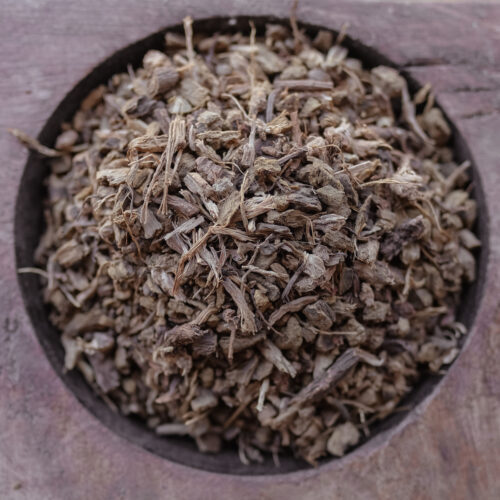
Yellow Dock Pieces
Yellow dock root, Rumex crispus, comes from a deep-rooted perennial native across temperate Eurasia and North Africa and has naturalized widely across the United States and grows throughout Washington state and elsewhere in meadows, fields, roadsides and other disturbed ground.
Its long taproot is yellow beneath the dark outer bark, while its tall seed stalks turn a rusty brown in autumn. Nicholas Culpeper placed docks under the rule of Jupiter and included yellow dock root among the old English herbs associated with blood, liver and skin preparations. In Armenia, women traditionally braid young dock leaves into aveluk, which is dried and saved for winter soups, salads and savory pies—a food tradition using the leaves rather than the dried root sold here.
Dried yellow dock root is firm, earthy and bitter, so it is usually simmered as a decoction rather than briefly steeped like a leaf tea. It can also be prepared as a tincture, infused vinegar, bitter elixir or part of a traditional herbal blend.
Appalachian storyteller and herbalist Ray Hicks remembered yellow dock as a “blood purifier” and used it alongside burdock in mountain folk preparations for skin troubles, arthritis and gout. After the European plant arrived in North America, Zuni herbalists also adopted it, using powdered root in poultices for sores, rashes and skin infections. 4 oz. – $6.25
$6.25